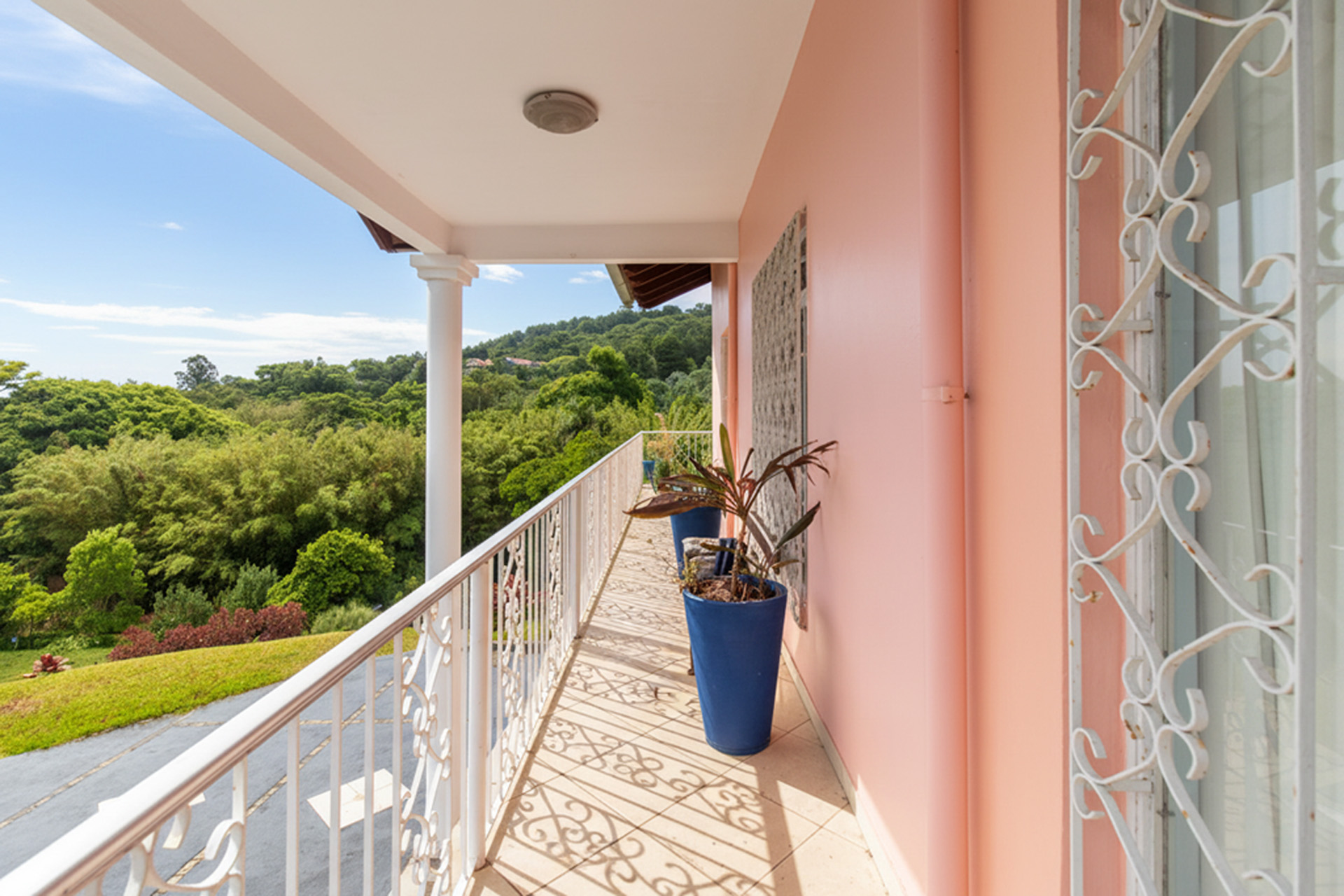
Focal length decides how the brain perceives the size of a room, which is why choosing the lens is the first technical decision of a real estate shoot. The useful range is 16 to 24mm in full-frame equivalent: below that, furniture in the corners stretches and the property stops looking like itself; above it, small rooms become impossible to show in full. Below: why that range, what changes between a full-frame and a cropped sensor, and the four-step workflow that keeps walls straight.
Why does focal length decide how the photo turns out?
Because it sets the proportions the viewer perceives, and proportions are what hold up a listing's credibility. The real pain point for an interior photographer is the tight spaces: compact bathrooms, narrow powder rooms, galley kitchens. Trying to capture them with the wrong lens produces two opposite problems. With longer focal lengths — above 24mm — you get visual claustrophobia: the room does not fit and the photo shows a fragment that explains nothing. With extreme ultra-wide lenses — below 15mm — you get unrealistic stretching: furniture placed at the edges of the frame gets pulled like elastic, misrepresenting the room's real size. That second mistake is the more expensive one, because it does not show on screen and it does show at the showing: the buyer arrives, sees a smaller living room than they imagined and the distrust spills over onto everything else in the listing. The 16–24mm range strikes the balance: enough angle to take in the main walls of a small room in a single shot, while keeping proportions true. It is the range covered by the wide-angle lenses Piperz asks of its network, such as a 16-35mm on full frame or a 10-18mm on APS-C.
What changes between a full-frame and an APS-C sensor?
The apparent focal length changes, and with it the lens you need to buy to get the same framing. The crop factor of an APS-C sensor — between 1.5x and 1.6x depending on the manufacturer — multiplies the focal length printed on the lens: a 10mm mounted on APS-C delivers roughly the same view as a 16mm on full frame. Anyone who ignores that math buys a 16mm for their cropped camera and finds out in the first kitchen that they are short on angle. For the Piperz network, which accepts either an APS-C or a full-frame body, what counts is the final framing, not the sensor: either one works if the focal length is chosen well. The table sums up what matters in practice:
| Parameter | Full-frame sensors | APS-C (cropped) sensors |
|---|---|---|
| Equivalent focal length to look for | 16 to 35mm | 10 to 18mm (or 10-24mm) |
| Edge sharpness and noise | Better, with more light gathering and less noise at high ISO — useful in dark interiors | Moderate; requires care with aperture to avoid losing definition at the edges |
| Cost | Higher investment, in lenses and in bodies | Very good value for getting started |
| Native distortion | Less prone to extreme geometric distortion | More pronounced barrel distortion at the short end (10mm); requires systematic digital correction |
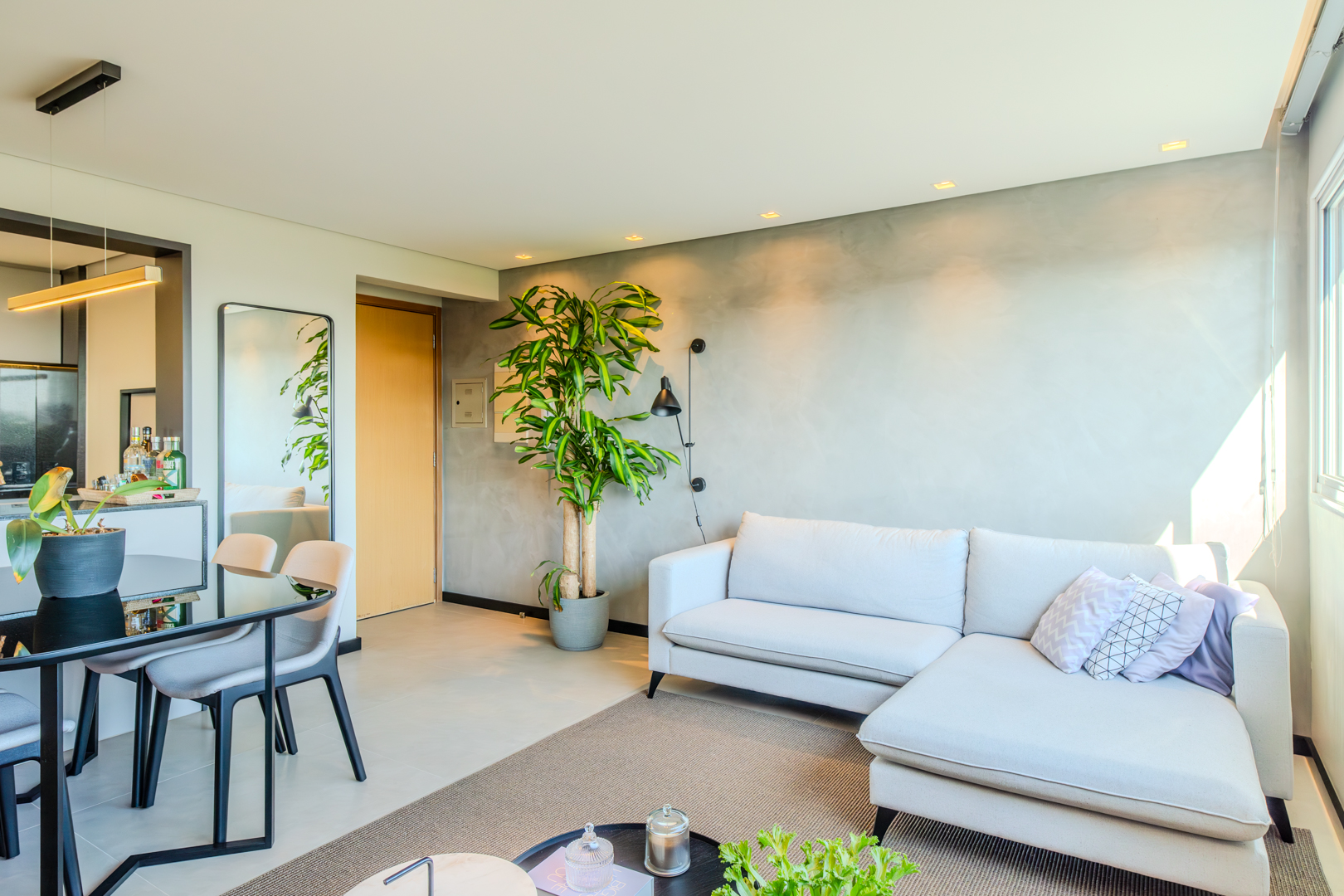
Difference in angle of view with a wide-angle lens in a living room
How do you avoid crooked walls and edge distortion?
With four decisions, two at capture and two in editing. The complaints brokerages and homeowners make about "leaning" walls almost never come from the lens: they come from the camera position. Verticals are, in fact, among the things Piperz evaluates in the real test shoot it uses to approve photographers for its network. The workflow that solves them:
- Leveling. A tripod with a three-way head or a precision geared head, and a level used every time — a physical bubble level or the camera's electronic horizon. Any tiny deviation on the horizontal axis makes the wall lines look like they are falling backward.
- Camera height. At about mid-height of the room, roughly 4 to 4.5 feet (1.2 to 1.4 m) off the floor. That keeps the lens parallel to the floor and drastically reduces the need to tilt the camera body up or down. Physical tilt is the main cause of converging walls.
- Profile correction in editing. Turn on lens profile correction in your raw processor: it identifies the lens model you used and surgically removes barrel distortion and corner vignetting.
- Aperture at the sweet spot. Avoid the maximum aperture (f/2.8 or f/4) so you do not lose definition at the edges. Between f/8 and f/11 you get corner-to-corner sharpness, depth of field suited to interiors and less chromatic aberration.
Which lens should you buy first if you can afford only one?
A wide-angle zoom that covers the whole useful range, before any prime. The temptation to start with a fast prime makes sense in portraiture and almost none in interiors: inside a property you cannot step back to frame, and being able to adjust from 16 to 24mm without moving from where the room lets you stand is worth more than a wider aperture — which you will not use anyway, because the work happens between f/8 and f/11 on a tripod. The second purchase, not the first, is a controllable light source. The third is a better tripod. Anyone who invests in the reverse order ends up with an excellent lens and crooked photos, which is exactly the problem the client sees. For anyone starting out who wants to join a network like Piperz, it helps to know that a wide-angle lens, a tripod and an external flash are among the gear requirements. How the rest of the kit fits around the lens is in real estate photography gear: the basic kit, and how that flash gets used is in what is the flambient technique.
Frequently asked questions
What is the best focal length for photographing properties without distorting the edges?
The 16 to 24mm range in full-frame equivalent, which on an APS-C sensor corresponds to roughly 10 to 16mm. Below 15mm equivalent, objects in the corners of the frame start to stretch, and above 24mm small rooms no longer fit in full. Within that range, the closer you get to 20mm, the more natural the proportions look.
How do you correct perspective distortion in editing?
First, turn on lens profile correction, which removes the barrel distortion and vignetting specific to the lens you used. Then, if the verticals are still falling, apply perspective correction to straighten them. The order matters: correcting perspective before the profile forces you to redo the adjustment. And keep in mind that every correction crops the image, so framing with some extra margin keeps you from losing part of the room.
Does a phone's wide-angle lens work for real estate photography?
For an internal reference, yes; for publishing, no. A phone's wide-angle lens has much more aggressive edge distortion and very little ability to recover a blown-out window, which is the most common situation in interiors. At Piperz, we see phone technique as a way to pull phone photos up toward the professional standard — never as a reason to lower the standard to what a phone can reach. The difference shows up precisely in the difficult rooms.
Do you need a stabilized lens?
Not for interior work, because the shoot happens on a tripod with long exposures, where stabilization adds nothing and on some bodies is even best turned off. Stabilization matters more for handheld exterior shots or walkthrough video. If you have to choose between a stabilized lens and one with better edge sharpness, the second one pays off more in this line of work.
The right lens does not make the photo, but the wrong one ruins it in a way no amount of editing can recover. To see how a technical standard holds up at volume, check out the Piperz software page.
Written by the Piperz Editorial Team
__Piperz__ is a platform dedicated to simplifying the secure delivery of real estate media, connecting photographers and helping brokerages and agents sell faster through professional imagery.