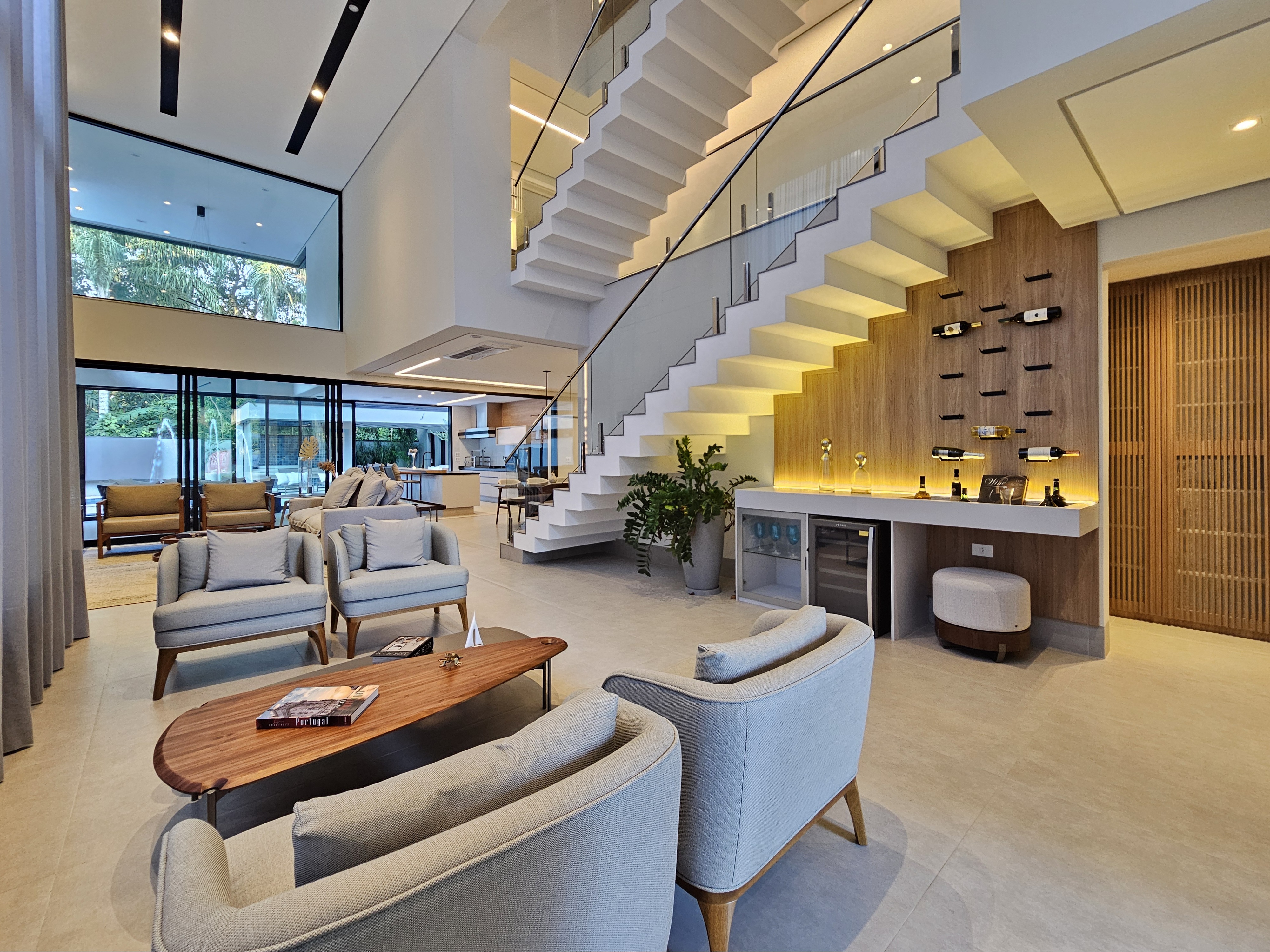
The real estate photography kit has four pieces and a buying order: a wide-angle lens, a tripod with a level, a flash with a tilting head and, only after that, a better camera body. Anyone who invests in the reverse order ends up with an excellent camera and crooked photos — which is exactly what the client sees. Below: what to choose in each category, why the sensor matters less than it seems and the two buying mistakes that burn the most money at the start.
Which camera and lens should you buy on a tight budget?
The lens, before the body. The optics set the ceiling on the quality of what you deliver, and the body just keeps up: a mid-range camera with the right wide-angle lens produces publishable listings, and an expensive camera with the kit lens does not. When it comes to the sensor, the practical difference is area. APS-C sensors apply a crop factor — typically 1.5x or 1.6x depending on the manufacturer — to the lens's nominal focal length, and cost less to buy, both in bodies and in compatible lenses: they are the best value for getting started. Full-frame sensors match the old 35mm film format, apply no crop, offer more dynamic range to recover detail in the shadows and produce less noise at high ISO, which matters in dark residential interiors. Neither one is a requirement for entering the market; the wide-angle lens is. That is also what Piperz asks of the photographers in its network: an APS-C or full-frame body, either one, and a wide-angle lens as a requirement.
Which wide-angle lens is the right one?
The equivalent of 16-24mm on full frame, which is the industry standard. That range lets you frame bathrooms, powder rooms and small kitchens in a single exposure without the room looking artificially narrow or claustrophobic. On cameras with an APS-C sensor, the actual focal length that matches it falls between 10 and 14mm, to make up for the crop factor: buying a 16mm for a cropped body is the most common math mistake, and you find out in the first kitchen. Models and ranges by sensor type are covered in best lenses for real estate photography. What you should avoid is the temptation to solve it with the lens that came with the camera: an 18-55mm at its widest gives a narrow angle that does not cover a small room in full, and forces you to shoot from the hallway. Piperz's requirements for its network include a wide-angle lens of that kind, such as a 10-18mm on APS-C or a 16-35mm on full frame.
Why does a fisheye ruin your portfolio?
Because it buys angle at the cost of credibility. The beginner's reasoning is understandable: if the problem is that the room does not fit, an 8mm lens with a 180-degree field of view solves it. What you do not see until you review the photos is that a fisheye produces extreme spherical distortion at the edges, curving the lines of floors, ceilings and walls. The result looks amateur at once, and brokerages reject it without needing to explain why: a curved wall tells the viewer the photo has been manipulated, and from then on they distrust everything else in the listing. That is why, at Piperz, we consider a fisheye unsuitable for interiors. The table sums up how each type fits, with focal lengths given for an APS-C sensor:
| Lens type | Typical focal length (APS-C) | Angle of view | Distortion | Suitability |
|---|---|---|---|---|
| Kit lens (18-55mm) | 18mm | Narrow (~74°) | Low | Poor: does not cover small rooms in full |
| Dedicated wide-angle | 10 to 14mm | Wide (~100° to 110°) | Controlled, straight lines | Excellent for interiors |
| Fisheye | 8mm | Extreme (~180°) | Very high, curved | Unsuitable: looks amateur |
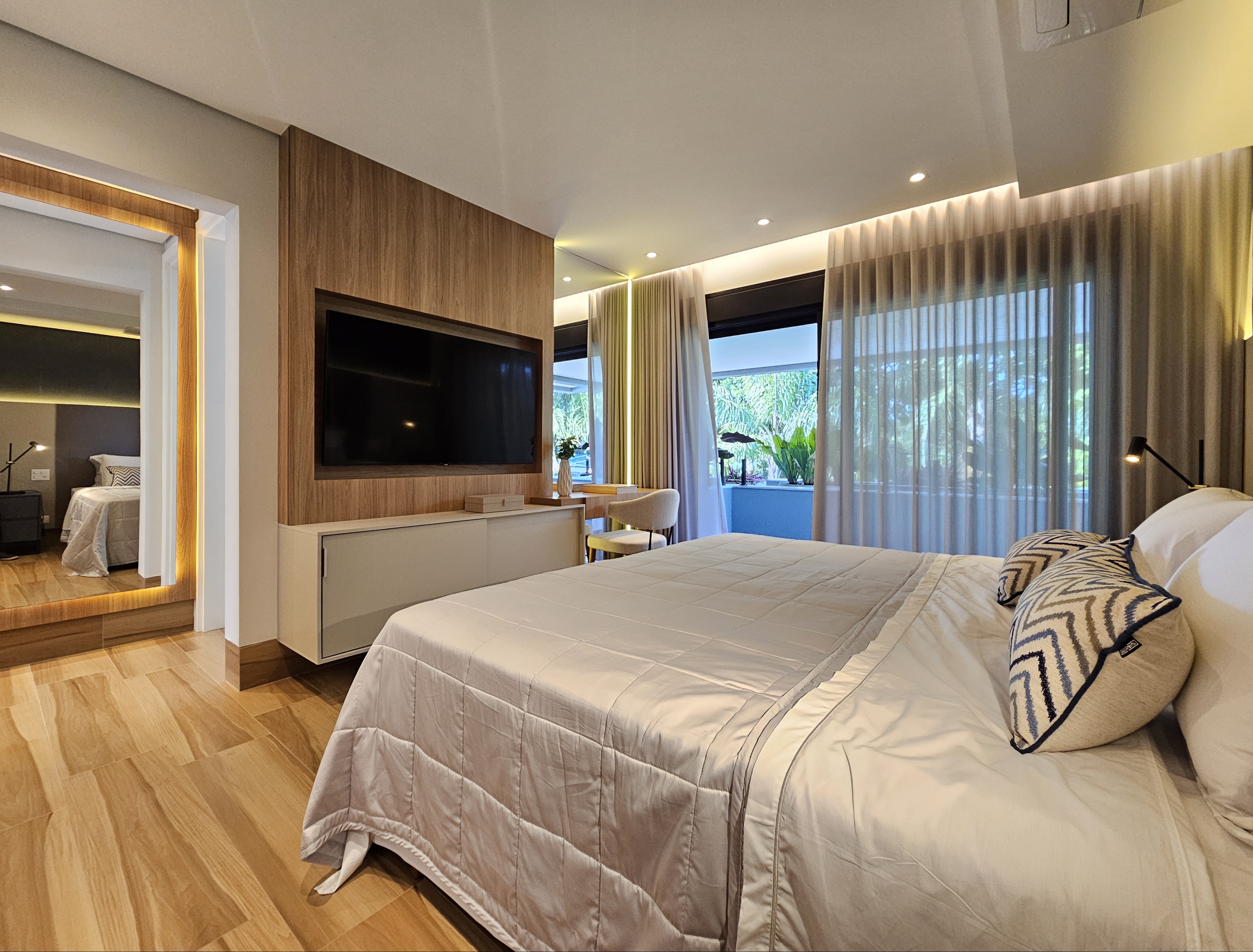
Spacious living room captured with a rectilinear wide-angle lens
Which tripod and lighting complete the kit?
Interiors are defined by the high contrast between dark rooms and sunny windows, and handling that takes mechanical support plus a fill light source. A tripod and an external flash are, in fact, among the requirements Piperz sets for the photographers in its network. Three pieces:
- Sturdy tripod with a level. It is the real estate photographer's most important accessory, ahead of the camera body. It guarantees parallel walls and sharpness at slow shutter speeds, which lets you keep ISO at its lowest native value and eliminate noise. It is essential for any multi-layer technique, where the pixels have to line up exactly.
- Flash with a tilting head. It makes fill flash possible: by aiming and bouncing the head off the ceiling or a white wall behind the frame, the light spreads out and cleans up the color contamination created by floors, tiles and lamps. It is what brings back true whites on furniture and walls.
- Collapsible reflector. Excellent value for filling in hard shadows and redirecting natural window light toward areas of interest, without needing a second flash.
Professional gear set up on a tripod during a real estate shoot
In what order should you buy if the budget comes in bit by bit?
Wide-angle lens, tripod, flash, body — in that order, and the reason is that each piece fixes a defect the client sees. The wide-angle lens solves the problem of the room not fitting, which is what makes a photo unusable. The tripod solves crooked walls and noise, which is what makes a photo look amateur. The flash solves color, which is what makes the property stop looking like itself — the technique behind it is in what is the flambient technique. The better body only adds margin in extreme situations, and it comes last because its absence is the least visible of the four. Anyone who invests in the reverse order has the most expensive gear in the group and the worst deliveries, and does not understand why. At Piperz, we recommend this order to anyone building a kit to work with brokerages. How that gear handles the hardest light in a property is in how to shoot interiors against window light, and how the standard holds up at volume is on the Piperz software page.
Frequently asked questions
What is the basic kit for starting out in real estate photography?
Four pieces: a wide-angle lens equivalent to 16-24mm on full frame (an actual 10 to 14mm on APS-C), a sturdy tripod with a level, a flash with a tilting head for bouncing and a collapsible reflector. The camera body matters less than people think at first: a mid-range model with the right optics produces publishable listings from the very first job.
What is the best lens for small rooms without distortion?
A rectilinear wide-angle lens in the range equivalent to 16-24mm. Rectilinear is the key word: it keeps the lines of walls, floors and ceilings straight, unlike a fisheye, which curves them. On an APS-C sensor that corresponds to an actual focal length of 10 to 14mm, and it pays to work between f/8 and f/11 to keep corner-to-corner sharpness.
Do you need full frame to work professionally?
Not to start. An APS-C body with the right wide-angle lens covers most residential work. Full frame adds dynamic range and less noise at high ISO, and that becomes relevant in very dark rooms or when volume makes every minute of editing count. It is a second or third purchase, not the first.
Why does the tripod matter more than the camera?
Because it fixes two defects the client notices and the camera does not solve: converging walls, which come from tilting the camera, and noise, which comes from raising the ISO so you can shoot handheld. On top of that, any multiple-exposure technique — which is how blown-out windows get fixed — depends on the camera not moving a millimeter between shots.
The right kit is not the most expensive one: it is the one that fixes, in order, the defects that keep people from looking at a listing. To see the standard you reach once that is solved, check out our customer cases.
Written by the Piperz Editorial Team
__Piperz__ is a platform dedicated to simplifying the secure delivery of real estate media, connecting photographers and helping brokerages and agents sell faster through professional imagery.