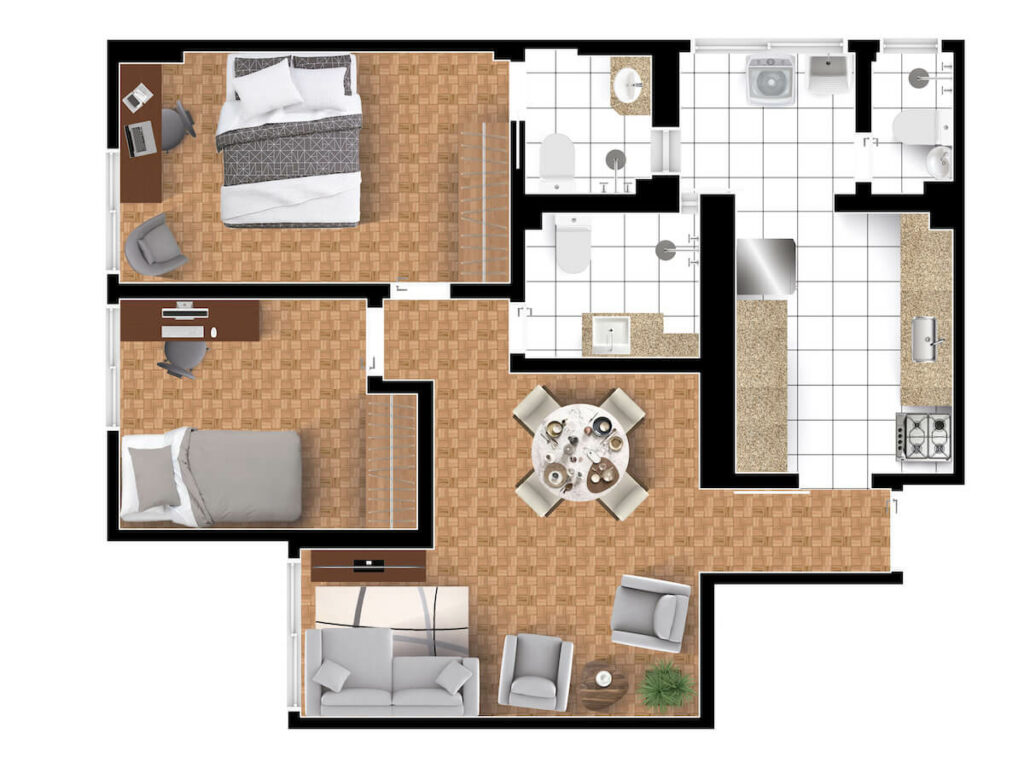
An empty room photographs smaller than it is. Buyers scroll past it because they cannot picture a sofa against that wall or a bed under that window. Virtual staging solves that by furnishing the photo instead of the room, and AI tools have made it fast enough that almost any listing can have it. That speed creates a new problem for a brokerage: staged images multiply, they look like ordinary photos, and without a rule they end up published without a label, mixed with the originals or reused on the wrong listing. This guide covers what virtual staging is, how AI staging compares with a staging company, how cost is usually set, why staged photos should be disclosed and how to manage them inside your media pipeline.
What is virtual staging in real estate photos?
It is the digital furnishing of a room from a photo of that room. A photographer shoots the empty space; furniture, rugs, art and lighting fixtures are then added on screen, so the listing shows how the room could be used. The structure stays the same: the walls, the windows, the floor, the measurements and the view are the ones the buyer will find at the showing. That is the whole point, and also the boundary. Piperz offers virtual staging as a service in Piperz's eight markets in Brazil, and describes it in exactly those terms: the rooms of an empty property are furnished digitally, starting from the professional photos of the shoot, and the brokerage receives the staged versions ready to publish together with the original photos. Piperz also offers physical home staging in those markets, and furniture added virtually inside a 3D tour for properties that are still under construction or vacant. Outside Brazil, Piperz does not stage properties; the Piperz software runs the media pipeline with your own photographers and vendors.
AI virtual staging or a staging company: what is the difference?
Speed against control, mostly. Self-service AI tools furnish a room in minutes: you upload a photo, pick a style and download the result. A virtual staging company has a person place and light the furniture, which takes longer and costs more per image, but gives you more say over scale, style and how the room reads. Physical staging is a third option, with real furniture, real logistics and the highest effort. The table compares the three generically.
| Self-service AI staging | Professional virtual staging | Physical staging | |
|---|---|---|---|
| Turnaround | Minutes | Usually days | Days to weeks, plus removal |
| Control over scale and light | Limited, varies by tool | High | Real furniture, real light |
| Effort for the brokerage | Upload and pick a style | A brief per room | Coordinating delivery and setup |
| Risk of distortion | Higher: furniture out of scale, odd shadows | Lower, reviewed by a person | None |
| Works for showings | No, photos only | No, photos only | Yes |
At Piperz, we recommend matching the option to the listing. AI staging can work for a quick test on a high-volume rental. A listing whose photos carry the marketing deserves a person checking that the sofa fits the room it sits in.
How much does virtual staging cost?
It depends on the pricing model more than on the tool, and the models are not directly comparable. Self-service AI tools usually charge per generated image or through a subscription. Virtual staging companies usually charge per edited image or per room, sometimes with a different rate for the style of furniture. Physical staging is priced by the size of the property and the length of the rental of the furniture. Before comparing quotes, convert them all to the same unit: the cost per published room, including any revision rounds. A cheap image that needs two corrections is not cheap. At Piperz, virtual staging in its Brazilian markets is quoted on request, by the number of rooms and the decoration style, and the quote is made together with the booking of the photo shoot. That keeps the staging attached to the shoot it depends on, instead of becoming a separate order with its own vendor and its own invoice. Whatever you choose, ask the vendor how many revisions are included and who owns the original photo after staging.

Living room photographed by a professional real estate photographer
Should you disclose virtually staged photos?
Yes. At Piperz, we treat disclosure as a point of view, not a legal opinion: a buyer should never discover at the door that the furniture was never there. Two practices make that easy. First, label every staged image, on the image itself or right next to it, with something like "virtually staged" or "illustrative furnishing." Second, publish the photo of the room in its current state alongside the staged one, so the buyer sees both. Rules on this vary by market, listing site and MLS, so check your MLS's photo rules and each listing site's published policy before you publish. Piperz applies the same practice to its own staging service in Brazil: on the Piperz service page, the recommended practice is to identify the image as virtual or illustrative decoration in the listing, and every staged image is delivered marked as such, with the original photo of the empty room. The line we draw is simple. Adding furniture to a room that exists is staging. Removing a utility pole, widening a bedroom or changing the view is altering the property, and Piperz does not alter structure, measurements, view or condition in any line of delivery.
How should a brokerage manage staged images in its media pipeline?
As a version of the shoot, never as a replacement for it. The failures with virtual staging are rarely about the image itself; they are about files. A staged photo gets uploaded without a label, the original is overwritten, or the staged version of one unit ends up on the listing of the unit next door. At Piperz, we recommend four rules for any brokerage, whatever tool produces the staging:
- Keep the original. Store the unstaged photo with its date next to the staged version. If a buyer ever questions the listing, the original is your evidence.
- Separate folders. Staged images live in their own folder, the same way clean and watermarked versions do, so nobody grabs the wrong set.
- Label in the file name. Add "staged" to the file name, so the label survives when the file is downloaded and shared.
- Approve staging separately. The listing agent checks the staged set against the original before it goes live.
The first two rules mirror Piperz's own delivery: Piperz keeps the original of each delivery, and its system already creates separate folders by use, with clean images for listing sites and, when switched on, watermarked images for the brokerage's channels. How those versions reach each channel is covered in which photo file to use on each channel.
When is virtual staging worth it for a listing?
When the room is empty and its use is not obvious. A vacant apartment, a new development with bare units, a room with an awkward layout or a space that could be an office or a bedroom are the classic cases. A furnished, well-kept home rarely needs it; the professional photos do the work. At Piperz, we recommend starting with the rooms that sell the property, usually the living room and the main bedroom, rather than staging every space. Staging a hallway adds files without adding meaning. Two other tools answer the same buyer question from different angles. A 3D tour lets the buyer walk the real layout, and Piperz's virtual staging inside a 3D tour is aimed precisely at properties under construction or vacant; the case for tours is in why 3D virtual tours qualify showings. For a brokerage running staging across many listings, the work is less about the image and more about the pipeline, which is what how to manage real estate photo and video production covers.
Frequently asked questions
What is virtual staging?
It is the digital furnishing of a room from a photo of that room. Furniture and decoration are added on screen, while the walls, windows, floor, measurements and view stay exactly as the buyer will find them at the showing.
Is AI virtual staging good enough for listing photos?
It can be for a quick test or a high-volume rental, but AI tools can place furniture out of scale or light it oddly. At Piperz, we recommend a person reviewing scale and light whenever the photos carry the listing's marketing.
Should virtually staged photos be labeled?
Yes. At Piperz, we recommend labeling every staged image as virtually staged and publishing the photo of the room in its current state alongside it. Rules vary by market and listing site, so check your MLS's photo rules and each site's published policy.
Does Piperz offer virtual staging in the United States?
No. Piperz offers virtual and physical staging only in Piperz's eight markets in Brazil. Outside Brazil, the Piperz software runs the media pipeline with your own photographers and vendors.
Virtual staging helps a buyer picture an empty room. Your pipeline decides whether that picture stays honest, labeled and attached to the right listing. To see how the Piperz software keeps every version of a shoot in order, talk to us.
Written by the Piperz Editorial Team
__Piperz__ is a platform dedicated to simplifying the secure delivery of real estate media, connecting photographers and helping brokerages and agents sell faster through professional imagery.